demo42
Narrated product demos, without losing a day.
You give it a URL and what you want to show. demo42 explores the product in a real browser, with a visible cursor, narrates every scene and hands back an MP4 ready to share. No script, no manual recording, no editor.
Nobody wrote a script, drew a storyboard or opened an editor. At the end, the tour fills in the contact form on its own: it was there, and it was the natural next step for whoever is watching.
Why it exists
GemLab runs several projects at once, and all of them change from one week to the next. When someone asks how one of them is going, the honest answer is to share the screen and click through it together.
Recording a proper demo solves that once: script, take, a mistake halfway, retake, cut, upload. A whole day of someone's time. On the next deploy the screen has changed and the demo is out of date. Multiply that by several projects and it is clear why nobody records it again.
- script, takes and editing
- a whole day of someone's time
- out of date on the next deploy
- a URL and a description
- a few minutes, nobody's hours
- recorded again when the screen changes
When a demo costs someone's day, it is an event. When it costs cents, it becomes a build artifact.
The interface changed? Record it again, like running the test suite after a commit.
How it works
A form with the URL and a description of what to show. A few minutes later, a video in the gallery. Along the way:
- 01
Explore
The planner browses the site in a real browser, reading and testing before it promises a scene. If the plan shows the search, it is because it typed into it and saw the autocomplete respond.
ai - 02
Plan
It writes the plan: the beats of the tour, in JSON. Never code.
ai - 03
Approve
The plan stops and waits for a person. Planning is fast and cheap; recording ties up a browser and an ffmpeg encode for several minutes.
person - 04
Compile
A compiler written by the team turns the JSON into a Playwright script.
code - 05
Record
The video comes from Chromium's screencast over CDP, one frame per page paint. The cursor is an injected, animated DOM element: synthetic input has no pointer.
code - 06
Narrate and assemble
The narration becomes a voice, the presenter gets a face and lip-sync, and ffmpeg assembles the cut with soundtrack and watermark.
aicode - 07
Check and publish
Four quality gates decide whether the video goes to the gallery.
code
The plan demo42 wrote for Mother
- 01establish
- 02survey
- 03traverse
- 04demonstrate
- 05reveal
- 06traverse
- 07close
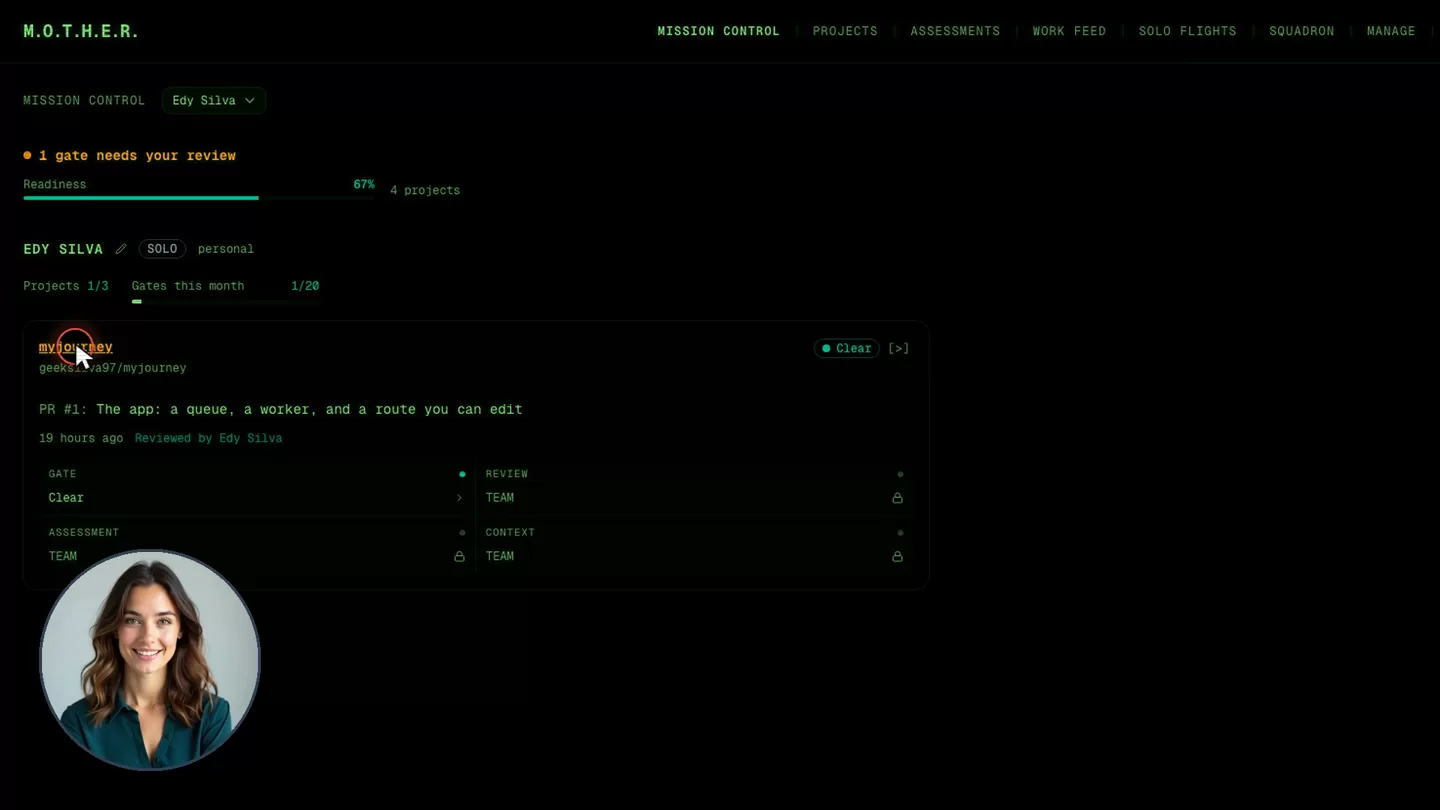
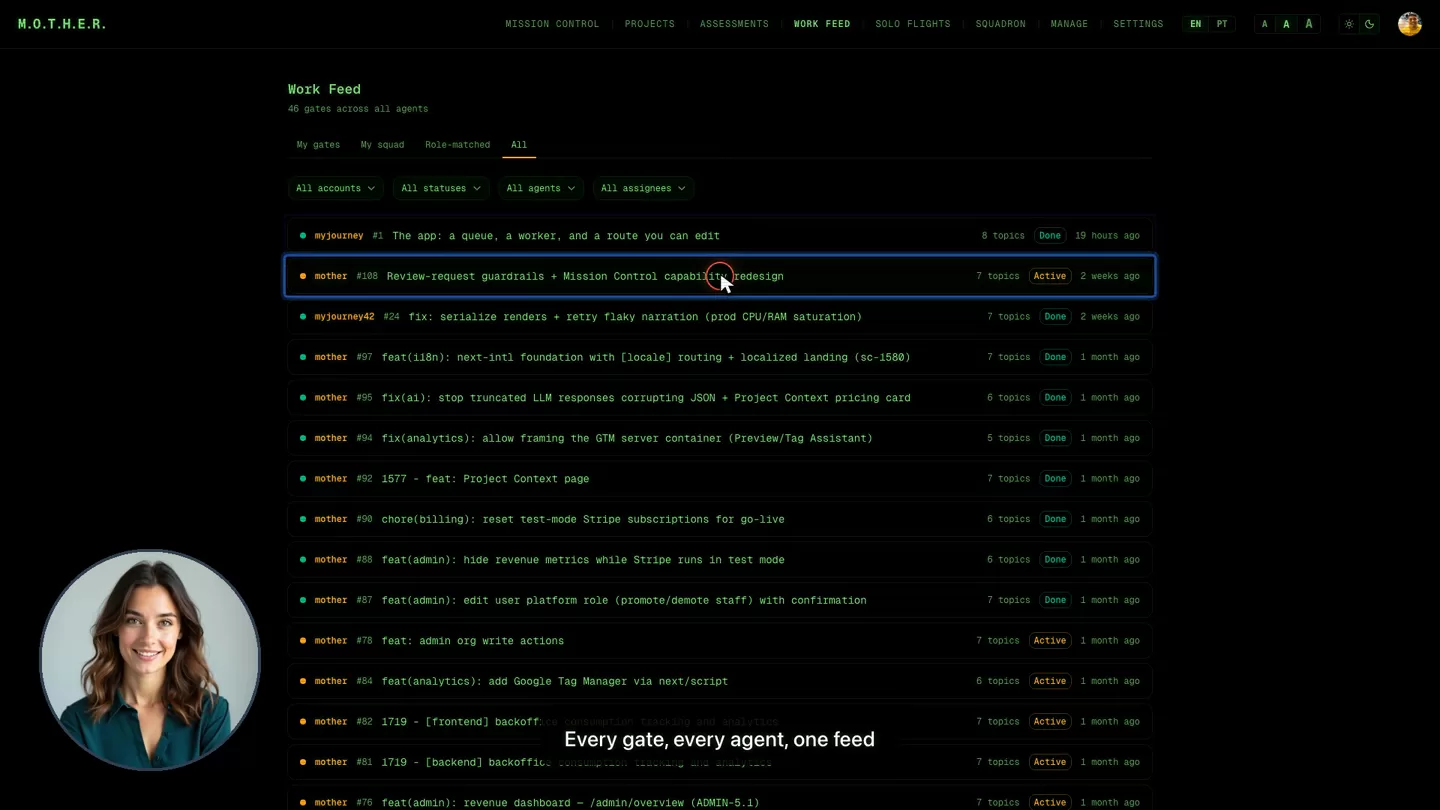
“The loop closes in Mission Control, where the next gate shows up as soon as your agent opens a pull request.”
The narration the planner wrote for the last beat. It found the product's loop and made it the tour's loop, without anyone asking. And the card under the cursor is demo42's own PR #1: Mother reviews demo42 while demo42 records Mother's demo.
Four gates before publishing
A job can finish successfully and be worth nothing. Each gate was born from a video that passed everything and was no good.
The compiler's validation: a bad plan becomes a validation error, never a syntax error.
It is structurally a demo: it opens by establishing, closes on a next step and has at least one demonstrate followed by a reveal.
At least 70% of the recording with something moving, measured per beat, from the video itself.
Detects blank screens and reads the text on screen looking for anti-bot challenges. google.com's reCAPTCHA used to pass the blank-screen test.
A gate measures what can be measured. Whether a screen is worth showing is still human judgement.
Architecture
Small on purpose: two processes and a database in a single file. No broker, no external queue. The queue is a table; an event is a row.
Either process can go down and come back without the other noticing. The server writes a row and responds; the worker takes the job with a lease; the page reads the same events from the database.
Recording runs on top of argo, which is open source. demo42 delivers the half argo assumes a person wrote: looking at a site it has never seen and deciding what the tour should be.
Decisions and trade-offs
Recorded as ADRs: the context, what the team decided and what it costs.
- Context
- Asking the model for the Playwright script directly works the first time. By the tenth, you get a file with a syntax error. Or worse: one that runs and does something nobody asked for.
- Decision
- The model writes a plan in JSON and a compiler written by the team generates the Playwright. The generated file is a thin shell around a literal; all the behaviour lives in tour-runtime.ts, written by hand and tested.
- Consequence
- A bad plan is a validation error, never a syntax error for someone to debug at 3 a.m. And the model cannot say what it should not: a goto only reaches the tour's origin, a key press only comes from a closed set, and there is no verb for "open another tab and log in somewhere else".
- Trade-off
- Expressiveness. A new capability is not a prompt tweak: it is a change to the compiler and its tests. Here the domain is closed on purpose, and the DSL wins by a wide margin.
const PLAN: TourPlan = { /* ... */ };
test('tour', async ({ page, narration }) => {
  await runTour(page, narration, PLAN);
});- Context
- Planning is fast and cheap. Recording ties up a browser and an ffmpeg encode for several minutes.
- Decision
- The script is written first and waits in the queue until someone says it is worth recording.
- Consequence
- Browser and encode time only go to approved tours.
- Context
- Filling in the contact form on its own is charming on a public site. The same enthusiasm applied to a delete button is not.
- Decision
- A beat that clicks declares its own risk, and validation recomputes that risk on its own. It refuses to click delete, buy, checkout, cancel subscription, invite or log out, no matter what the plan declared.
- Consequence
- Hovering over a delete button to show that it exists is fine. Pressing it, never.
- Context
- Nearly every product worth a demo lives behind a login. A tour that only sees what a stranger sees is a tour of the wrong half.
- Decision
npm run loginopens a real browser. You sign in however the app asks (password, SSO, 2FA, magic link, hardware key) and press Enter.- Consequence
- It works with any login, because a person does it, not a script guessing selectors. No password is typed, stored or seen by a model.
- Context
- A recording job takes minutes, and the page needs to follow its progress live.
- Decision
- Two processes and a database in a single file. The server writes a row and responds; the worker takes the job with a lease and logs progress; the page follows over SSE reading the same events.
- Consequence
- Either process can go down and come back without the other noticing.
- Context
- The pipeline worked on day one, and the video was worthless: 46% to 54% of each video was a still frame. The narration set the length of the beat, and the leftover time became a photo.
- Decision
- Every beat declares a shot and has an elastic action that grows to fill the narration: drift scrolls the page, sweep takes the pointer across several targets, push moves the camera in ffmpeg. Hold still exists, capped at 800 ms.
- Consequence
- The video moves nearly all the time and feels like a tour someone recorded, not a narrated slideshow. Allocation is decided live: if a navigation is slow, the following actions shrink.
AI in the process
The only place with a large model is planning. The rest of the pipeline is machinery, labelled by name, and each piece was chosen by experiment, not by hunch.
In one of the first tours, the planner made 18 exploration calls for seven beats that passed validation on the first try.
The GemLab team did the research the way it works in the lab: with Claude Code.
With it, the team surveyed open and commercial models, wrote the reports behind the choice and ran the experiments that produced the numbers alongside. Each experiment became a lab notebook in the repository, with costs and measurements.
WAN 2.6 does not stop talking: it keeps "chewing air" during pauses. InfiniteTalk is driven by the audio, so the mouth stops when the voice stops, in any language.
Ruled out before testing: Wav2Lip, MuseTalk and LatentSync, which dub existing video. Here there is only a still portrait.
A tour in another language is not a translation: the plan is redone from scratch in the target language. In Portuguese, the planner found a path through the site that the English tour never touched.
Method and next steps
Kent Beck's old advice: make it work, make it right, make it fast. Making it work was the first step; demo42 is in the middle of the list.
make it work
The end-to-end path has worked since day one: a URL and a description go in, a narrated MP4 comes out.
make it right
Quality: gates before publishing, motion in every beat and limits the model cannot cross.
make it fast
Re-record and swap parts of the video (a scene, a narration, a brand) without paying for the whole path again. And longer tours: today the ceiling is one minute.
Team
100% GemLab.
From the product to the model research, demo42 was built end to end by the GemLab team, Codeminer42's AI-first lab.
Ready to build real software?
Tell us what stage your idea or product is at. GemLab evaluates the context and indicates the best route to transform potential into an operational product.
Bring my product to the lab bench